
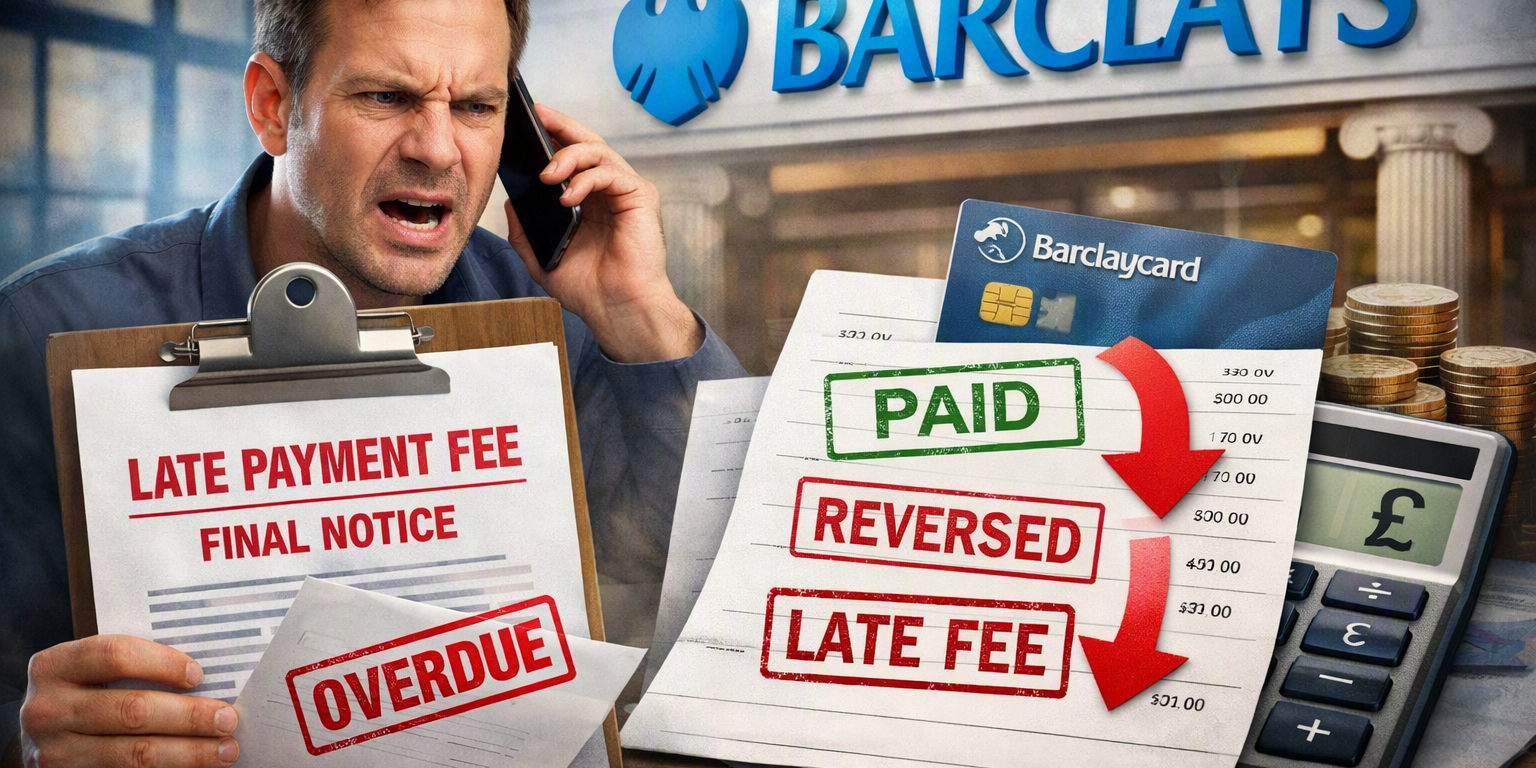
How Barclays Reversed My On‑Time Payment, Blamed Me, and Issued a Late Fee
When you do everything right, you expect your bank to do the same. Unfortunately, that wasn’t my experience with Barclays this month.
Barclays usually gives me seven days’ notice before a credit card payment is due. That window matters — it gives me time to move money into my main account so the direct debit can be collected without any issues. This time, however, they gave me only four days’ notice. It was inconvenient, but I still managed to get the funds in place and Barclays successfully took the payment on the scheduled date.
After the payment was collected, I decided to cancel my direct debit. The payment had already gone through, so there was no reason for anything to change.
But Barclays then did something completely unexpected: They refunded the entire credit card payment back to my account.
I didn’t request a refund. I didn’t dispute the payment. Barclays simply reversed a perfectly valid, on‑time transaction. I waited for the refund to clear and then manually repaid the credit card bill myself.
And despite all of that — despite the fact that the original payment was made on time — Barclays issued a late payment charge.
Let’s be clear:
- The payment was made on time.
- Barclays reversed it without my involvement.
- The “late” payment only existed because Barclays created the problem.
So why was I being charged for their mistake?
When I phoned Barclays to challenge this, they tried to claim that I didn’t have enough funds in my account to cover the credit card bill. However, I have clear evidence showing that I transferred the necessary funds on the Friday, the money cleared on the Monday, and the payment was due on the Tuesday. The timeline proves the funds were available well before the payment date. Despite this, Barclays continued to shift the blame onto me rather than acknowledging their own error.
After further discussion, Barclays did eventually refund the late payment charge — but only after I pushed back and provided proof. While I appreciate that the fee was refunded, the situation should never have occurred in the first place. Customers shouldn’t have to fight to correct mistakes caused by the bank’s own processes.
This experience highlights how easily customers can be penalised even when they follow the rules. A shortened notice period, an unexplained refund, and an automatic late fee — all caused by the bank, not the customer.
What Others Should Do If This Happens to You
If you ever find yourself in a similar situation — where a bank reverses an on‑time payment, applies a late fee, or tries to shift the blame — here are the steps you should follow:
1. Gather Your Evidence Immediately
Document everything:
- The date you transferred funds
- When the money cleared
- The scheduled payment date
- Any notifications the bank sent A clear timeline is your strongest defence.
2. Contact the Bank and Challenge the Charge
Explain the situation calmly but firmly. Stick to the facts and refer directly to your evidence. If the bank reversed an on‑time payment, make that point repeatedly.
3. Request a Refund of Any Charges
If the bank’s actions caused the issue, you should not be paying for it. Ask them to remove or refund the late payment fee.
4. Ask for a Written Final Response
If the bank refuses to resolve the issue, request a Final Response Letter. This is required before you can escalate the matter to the Financial Ombudsman Service.
5. Escalate to the Financial Ombudsman Service (FOS)
If the bank won’t fix the problem, the Ombudsman can. They will review the evidence, the timeline, and the bank’s actions. Cases like this — where the bank reversed an on‑time payment — are typically viewed as the bank’s error.
6. Keep Records of Everything
Save call logs, emails, chat transcripts, and screenshots. If the issue escalates, having a complete record strengthens your case.